
Alex Reed, partner and consultant sales manager at Electrolux Professional UK & Ireland, discusses the key commercial catering equipment categories that can help reduce energy usage without compromising on performance.
There is no escaping the fact that cooking is an energy-intensive activity. Whether you are roasting, grilling, washing or chilling, energy is constantly in use.
Fortunately, achieving carbon net zero isn’t the sole responsibility of the chef or procurement team. A lot of the work will take place in front of the meter, with further integration of renewable power sources into the national energy mix to reduce our reliance on fossil fuels.
However, when it comes to inside the kitchen, there are several key category items that can help curb energy use without compromising on performance.
Refrigeration
Refrigeration is among the most energy-intensive areas of a commercial kitchen as it is ‘always on’. However, it is also one of the most regulated, making it much easier to identify more efficient models. The two key pieces of information to consider are the energy label (which goes from A to G) and the Climate Class.
The energy label displays the annual energy consumption (kWh/annum) and the total recommended capacity, while the Climate Class determines the capability of the product to correctly preserve food in different working conditions. Given how hot a professional kitchen can get, operators should look for appliances with Climate Class 4 or 5. This will ensure the unit will operate efficiently, even if the ambient temperature reaches 30- 40°C. Within the Electrolux Professional ecostore range of refrigerated cabinets there are several models rated to an energy efficiency class A and Climate Class 5.
The final way refrigeration could influence your net zero plans is the refrigerant gas used within the appliance. Most Electrolux Professional models use the natural R290 refrigerant gas. This is both more sustainable than hydrofluorocarbon (HFC) refrigerants, and less corrosive of core internal parts such as the compressor.
Induction
Making the switch from gas burners to induction hobs can have a huge impact on a commercial kitchen – both in terms of reducing energy consumption and improving the working environment for the chefs.
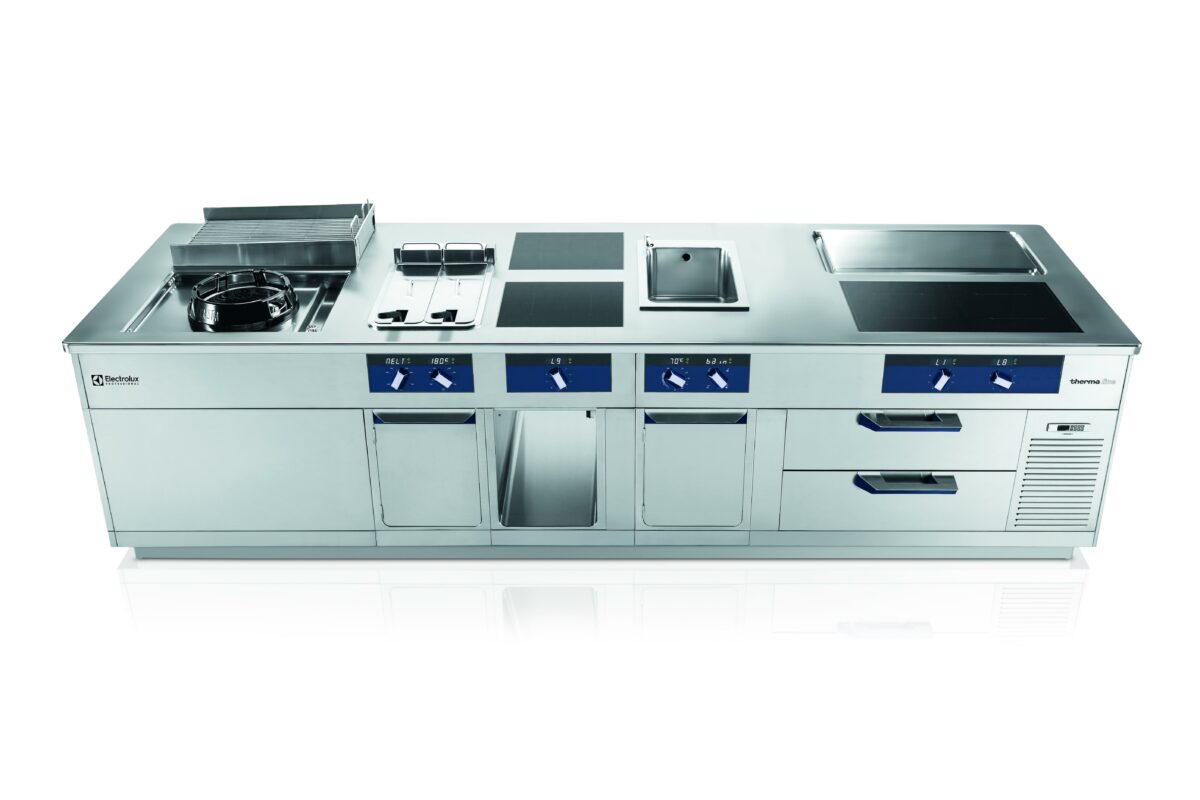
Electrolux Professional’s range of cooking equipment solutions, including XP and thermaline, can be tailored to a chef’s exact requirements, including induction. Induction cooking systems can achieve up to 90% energy efficiency, with our thermaline induction hob having nine different power settings and available in either full surface or single point induction. The Ecotop reduces heat dispersion away from the cooking plate by 35%, while still reaching temperatures of up to 450°C.
Warewashing
Traditionally, warewashing has accounted for around 15-20% of total operating costs for caterers. However, that figure is likely to have increased even further due to the current nature of commercial energy prices.
Electrolux Professional’s green&clean range is among the most energy-efficient series of warewashers on the market. Available in undercounter, hood type, dual rinse rack and multi rinse rack formats, each unit features a high-power washing circuit to guarantee spotless results regardless of item placement. During each cycle, the built-in atmospheric boiler raises the water to a constant temperature of 84°C, with the Wash-Safe Control light turning green to confirm.
It seems obvious, but the less water you need to heat, the more efficient the appliance – crucially, the hood type has a consumption of just two litres of water per cycle, with the dual rinse rack machine being even more efficient, at 1.2 litres per basket. Combined with the Energy Saving Device (ESD), this results in a 30% saving on water, and a 32% saving on detergent, allowing caterers to cut their operating costs by up to 22% each year.
Conclusion
A final point to consider is improving access to energy efficient catering equipment, as this will go a long way to helping the sector work towards achieving carbon net zero. I strongly endorse the Foodservice Equipment Association’s three-point plan of manufacturer tax credits, a funded end-user scrappage scheme and the development of Energy Technology List qualifying criteria for foodservice equipment.
Ultimately, collaboration between manufacturers, operators and regulators will play an important role in the journey to net zero, and I hope the dialogue will remain open and honest.
